The Ultimate Guide to B2B Website Visitor Tracking Tools
Unmasking Your Anonymous Website Traffic
Are you losing revenue-ready B2B prospects because your website visitors remain anonymous?
Every day, high-intent buyers decision-makers actively researching solutions visit your website, explore key product pages, compare offerings, and then disappear without filling out a form or booking a demo. These aren’t cold visitors. They’re warm prospects. And when they leave unidentified, your sales team never even knows they existed.
This invisible traffic isn’t just frustrating it’s expensive. You’re investing heavily in paid media, SEO, content, and ABM campaigns to drive the right accounts to your site. But without visibility into who is visiting, marketing teams can’t personalize experiences, RevOps can’t optimize funnel performance, and sales teams are forced to operate reactively instead of proactively. The result? Low conversion rates, underperforming lead nurture programs, misaligned sales and marketing efforts, and missed revenue opportunities hiding in plain sight.
That’s where B2B website visitor tracking tools change the game.
This ultimate buyer’s guide cuts through the hype to show you how modern visitor identification platforms can transform anonymous website traffic into actionable account-level intelligence. You’ll learn how these tools work, what capabilities actually drive ROI, and how leading B2B organizations are using them to improve pipeline velocity, prioritize sales outreach, and increase revenue efficiency. We’ll also break down the top solutions available in 2026 and provide a clear, strategic framework to help you choose the right tool for your go-to-market motion.
If your goal is to stop guessing, start selling smarter, and turn hidden website activity into measurable revenue growth this guide is built for you.
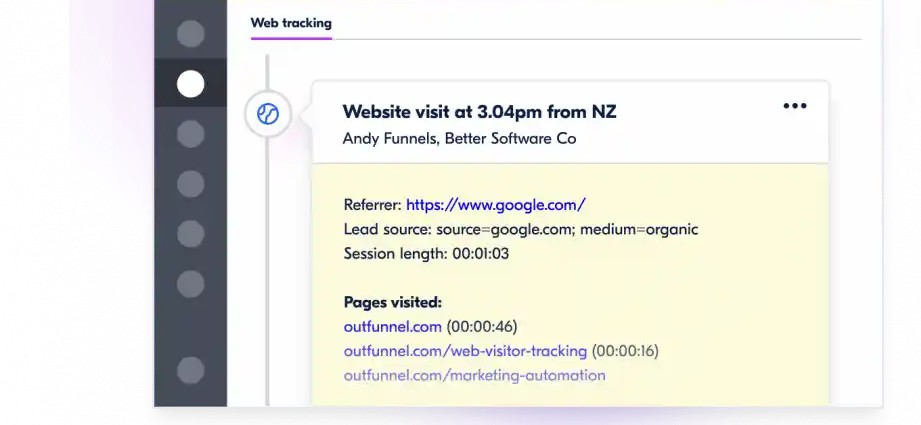
Understanding B2B Website Visitor Tracking The Foundation for Growth
What Is B2B Website Visitor Tracking?
B2B website visitor tracking is the process of identifying which companies (not individual users) are visiting your website by matching visitor IP addresses to large firmographic and business intelligence databases. Instead of seeing vague metrics like sessions or page views, you gain visibility into the actual organizations researching your solutions.
The core purpose is simple but powerful: reveal buying intent earlier. These tools surface businesses that are actively exploring your product pages, pricing, or case studies before they ever submit a form or speak to sales.
This capability represents a fundamental shift in go-to-market strategy. Traditional B2B marketing is reactive, waiting for prospects to self-identify via gated content or demo requests. Visitor tracking enables a proactive model, where marketing and sales teams can identify, prioritize, and engage high-fit accounts while interest is highest.
Most importantly, it directly addresses one of the most costly B2B blind spots: anonymous website traffic. When you don’t know who’s visiting, valuable sales opportunities quietly slip through the cracks.
Why Does It Matter for B2B Sales & Marketing?
In today’s crowded and competitive B2B landscape, speed and relevance win deals. Website visitor tracking gives teams a strategic edge by turning passive website activity into actionable intelligence.
For sales teams, it enables early, informed engagement with warm or even hot accounts that are actively researching solutions. Instead of cold outreach, reps can prioritize companies already demonstrating intent.
For marketing teams, it provides clarity on what content and campaigns are actually influencing target accounts. This insight supports smarter personalization, stronger ABM execution, and better alignment with sales around high-value opportunities.
Expert Tip: Define your Ideal Customer Profile (ICP) first. Clear ICP criteria industry, company size, revenue, geography will help you evaluate which tools offer the most accurate and relevant visitor identification for your target accounts.
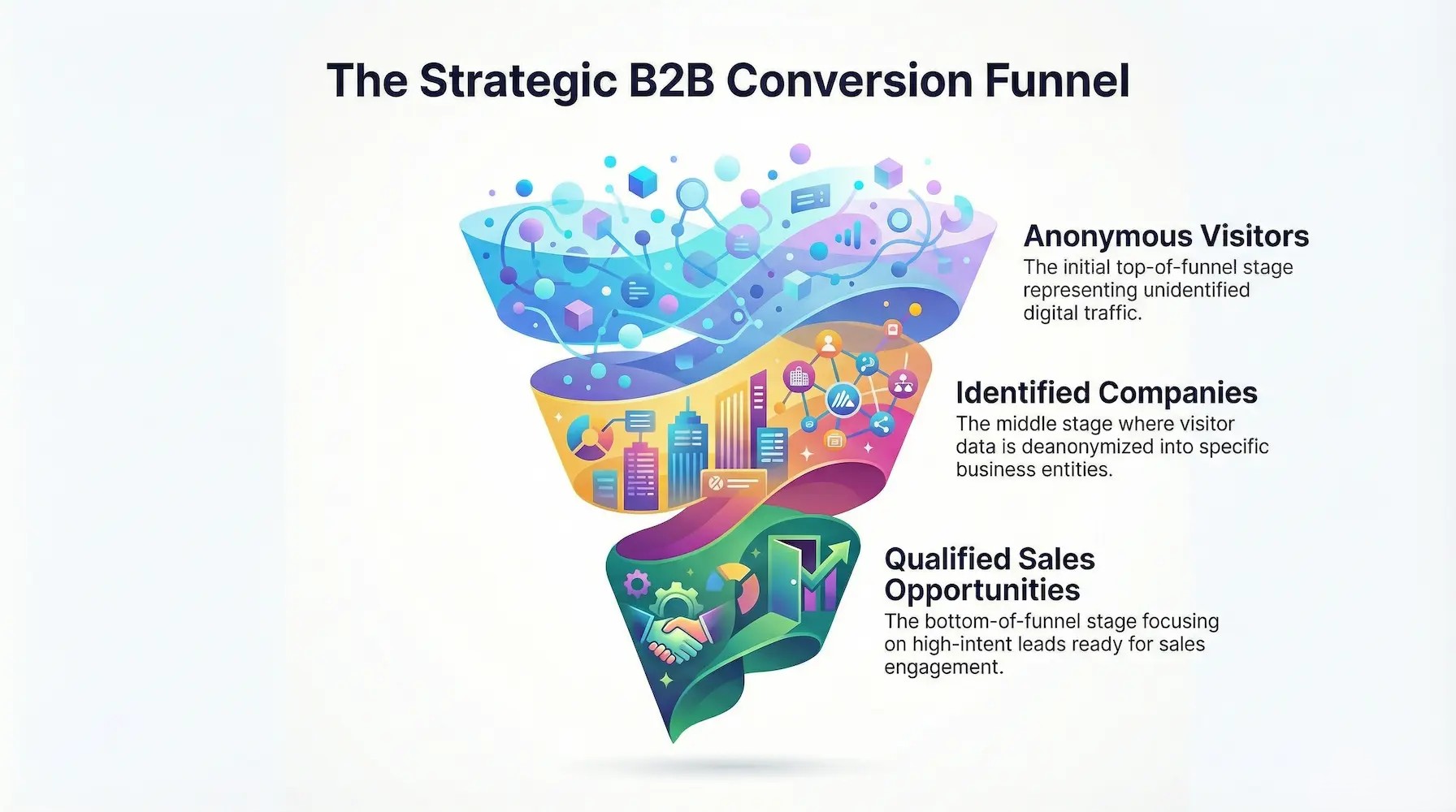
How the Technology Works: Demystifying the Process
B2B website visitor tracking may sound complex, but the underlying technology follows a clear, logical flow. Understanding how it works helps marketing, sales, and RevOps leaders evaluate tools more confidently and set realistic expectations around accuracy and ROI.
Reverse IP Lookup: The Foundation
At the core of most B2B visitor tracking platforms is reverse IP lookup. When a company employee visits your website, their IP address is captured and matched against large databases of publicly available and proprietary business IP data. This process allows the tool to identify the company behind the visit, not the individual aligning with B2B privacy standards and buying behaviors.
Cookies & Tracking Scripts: Session Intelligence
Tracking scripts and cookies are used to monitor on-site behavior such as pages viewed, visit frequency, and engagement depth. While these technologies support session-level insights, the primary value in B2B remains company-level identification, helping teams understand which organizations are showing interest and what they care about.
Firmographic Data Enrichment: Turning IDs into Insights
Once a company is identified, the IP data is enriched with firmographic details pulled from third-party databases. This typically includes industry, company size, estimated revenue, location, and sometimes tech stack giving teams immediate context to assess account fit against their ICP.
Intent Data Signals: Gauging Buyer Readiness
More advanced platforms layer in intent data, analyzing broader online behavior to determine what topics or solutions a company is actively researching. When combined with on-site activity, this creates a more complete picture of buyer readiness, helping sales prioritize outreach and marketing tailor messaging.
Data Flow: From Visit to Revenue Action
In practice, the data flow is straightforward: a company visits your website, their IP is identified and enriched with firmographic and intent data, and the insights are pushed into your CRM or marketing automation platform. From there, teams can trigger alerts, score accounts, and activate targeted sales or ABM workflows.
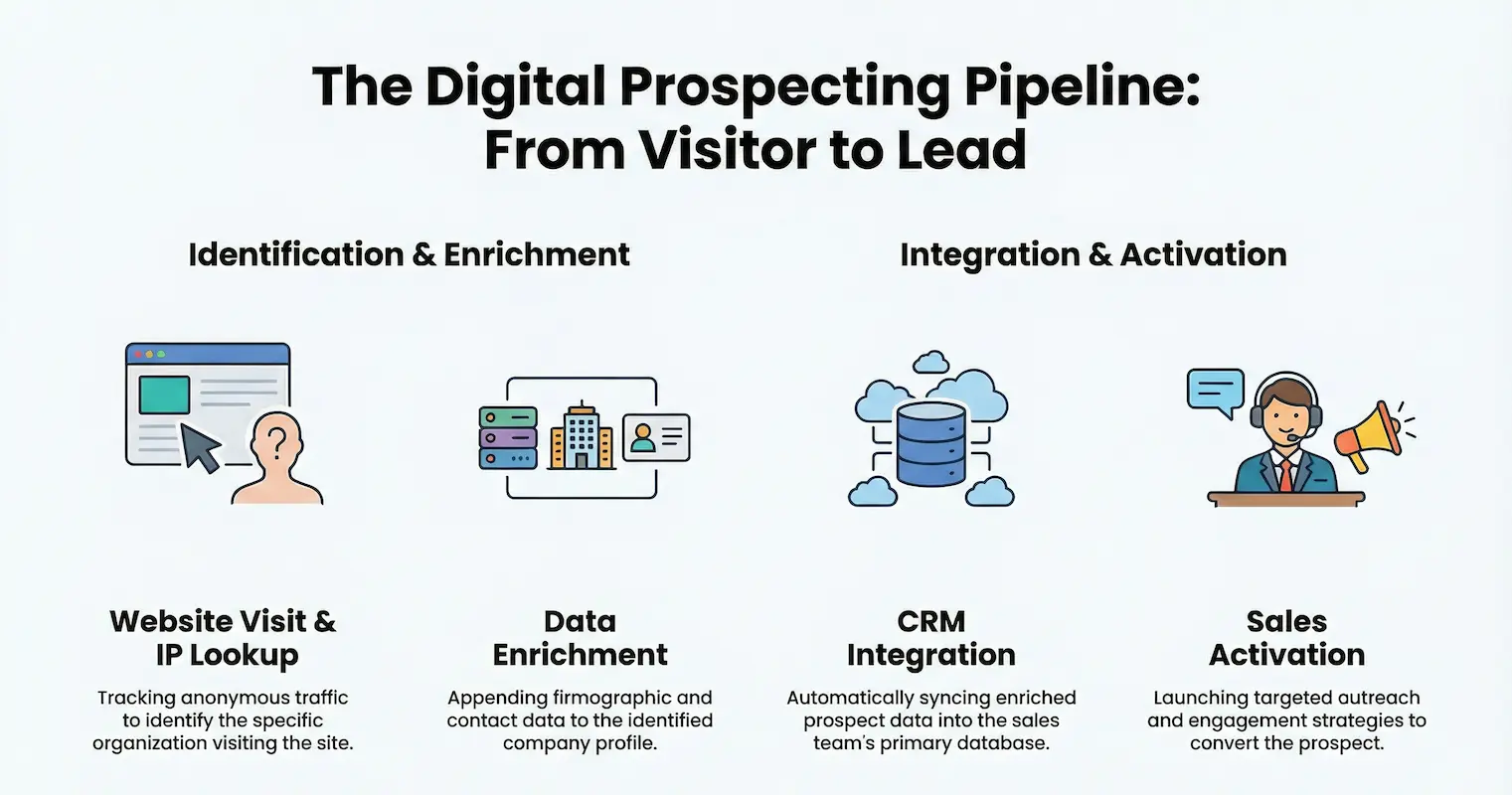
The Transformative Power: Key Benefits for Your B2B Business
When implemented strategically, B2B website visitor tracking doesn’t just add visibility it reshapes how sales and marketing teams operate. The real value lies in how these insights translate into faster decisions, better targeting, and measurable revenue impact.
Boosting Sales Efficiency & Targeting
One of the most immediate benefits is smarter lead prioritization. Instead of working from static lead lists, sales teams can focus on companies actively visiting high-intent pages such as product features, pricing, or case studies. This directly tackles a common revenue blocker: low conversion rates caused by poor lead quality and timing.
Visitor tracking also enables highly targeted outreach. When reps know which pages an account viewed and how often they returned, conversations shift from generic pitches to relevant, value-driven discussions. This context increases response rates and shortens sales cycles.
Another major efficiency gain is the reduction in manual research. Instant access to firmographic data industry, company size, location, and revenue eliminates time-consuming lookups and manual data entry. Sales reps spend less time researching and more time selling.
Expert Tip: Prioritize tools that turn data into action. Features like lead scoring, intent signals, and real-time alerts ensure visitor insights are immediately usable not just interesting.
Elevating Marketing Personalization & ROI
For marketing teams, visitor tracking unlocks a new level of personalization and performance optimization.
Identified company data can power dynamic website personalization, allowing you to tailor messaging, CTAs, or content offers for returning visitors from target accounts. This relevance improves engagement and nudges prospects further down the funnel.
On the campaign side, visitor tracking reveals which channels and campaigns are driving high-value company traffic, not just clicks. This insight helps eliminate wasted ad spend by reallocating budget toward sources that attract ICP-aligned accounts.
It also strengthens content strategy. By analyzing which articles, guides, or pages identified companies consume most, marketers can double down on proven topics and uncover content gaps that matter to real buyers.
Finally, the best tools go beyond surface-level data by offering feature-specific advantages for B2B teams. For example, reverse IP lookup combined with ABM workflows can alert sales the moment a target account visits your pricing page enabling timely, personalized follow-up that competitors miss.
Expert Tip: Don’t overlook website personalization. Even small adjustments such as industry-specific messaging or tailored CTAs can significantly improve conversion rates when powered by visitor tracking data.
Improving Sales–Marketing Alignment & Collaboration
B2B website visitor tracking plays a critical role in breaking down silos between sales and marketing by creating shared intelligence around prospect and account behavior. Instead of operating from separate dashboards and assumptions, both teams gain a unified view of which companies are visiting, what content they’re engaging with, and where they are in the buying journey.
This directly addresses one of the most persistent B2B challenges: poor sales–marketing alignment caused by disconnected data and limited visibility into website activity. When both teams are working from the same engagement signals, conversations shift from finger-pointing to coordinated action.
With shared insights, sales and marketing can develop joint account strategies. Marketing can nurture identified target accounts with relevant content and campaigns, while sales times outreach based on real buying signals such as repeat visits to solution or pricing pages. The result is smoother handoffs, higher-quality conversations, and more consistent pipeline progression.
Expert Tip: Align on how the data will be used before rolling out a tool. Establish clear SLAs and processes defining when marketing alerts sales, how sales should follow up, and how outcomes are measured. This prevents confusion and ensures the data drives action, not noise.
Expert Tip: Evaluate the funnel view, not just identification. The most effective tools help teams visualize and track how identified companies move from first visit to sales-ready opportunity supporting better forecasting, attribution, and RevOps decision-making.
Choosing Your Edge: Essential Features to Look For
Not all B2B website visitor tracking tools deliver the same level of value. To drive real revenue impact, buyers should evaluate platforms based on how well they identify the right companies and how seamlessly that data activates across the revenue stack.
Expert Review: The Best B2B Website Visitor Tracking Tools ( 2026Roundup)
Before diving into the top solutions, it’s important to note that our evaluations are objective and hands-on, designed to help B2B marketing, sales, and RevOps leaders make informed decisions. Some tools reviewed may have affiliate links, but all assessments are based on actual testing, expert analysis, and industry benchmarks, not promotional considerations.
Our team, with professional experience in B2B technology and revenue operations, assessed each tool through live trials, demos, and feature walkthroughs, focusing on real-world utility for sales acceleration, account identification, and marketing optimization. Evaluations were cross-referenced with trusted industry sources such as Gartner, Forrester, G2, and Capterra to ensure accuracy and credibility.
Key aspects reviewed include:
·Identification accuracy & data enrichment – how reliably the tool uncovers anonymous companies and enriches them with firmographic and intent data.
·CRM and marketing automation integrations – seamlessness and ease of mapping visitor data into existing workflows.
·Actionable reporting & analytics – dashboards, ROI tracking, and customizable reports.
·Lead scoring & alerts – behavioral and firmographic scoring with real-time notifications.
·User experience & scalability – intuitive interface, customization options, and ability to grow with your business.
Each review below clearly states how we tested the tool, the features evaluated, and any limitations or standout strengths, giving you transparent, actionable insights for 2026.
Leadfeeder: Turn Anonymous Website Traffic into Actionable Leads
Evaluation Methodology: Based on a 14-day free trial of Leadfeeder’s Pro plan, we tested reverse IP identification, visitor behavior tracking, and CRM integrations. Our team, experienced in B2B sales and ABM, focused on how efficiently the platform surfaces high-value accounts and supports sales follow-up workflows. Ratings from G2 (4.4/5) and Capterra (4.5/5) were cross-referenced to validate real-world usability.
Key Features & Unique Selling Points
Reverse IP Lookup – Accurately identifies visiting companies and uncovers accounts browsing your site anonymously.
Advanced Filtering – Pinpoint target accounts based on industry, location, company size, and engagement.
Seamless CRM Integrations – Native connections with HubSpot, Salesforce, and Pipedrive for automated lead creation and workflow syncing.
Leadfeeder Contacts – Helps identify individuals within target accounts for personalized outreach.
Visitor Behavior Tracking – See which pages and content visitors engage with most to prioritize follow-up.
Ideal Use Cases & Target Audience
·Mid-market B2B companies aiming to improve ABM strategies.
·Sales teams seeking early insight into warm accounts.
·Marketing agencies supporting multiple client campaigns with account-level analytics.
Pros & Cons
Pros:
Intuitive, easy-to-use interface.
Strong filtering and segmentation options.
Reliable CRM integrations for sales activation.
Cons:
Pricing can rise for high-traffic websites.
Primarily company-level insights; less individual-level detail without add-ons.
Pricing Overview & Free Trial Options
Tiered pricing based on the number of identified leads per month.
Offers a 14-day free trial to test core features.
Expert Insight
"Leadfeeder has transformed how our sales team prioritizes accounts. We no longer wait for inbound forms we can see which companies are actively researching solutions and reach out with confidence." – B2B Sales Director, Mid-Market SaaS
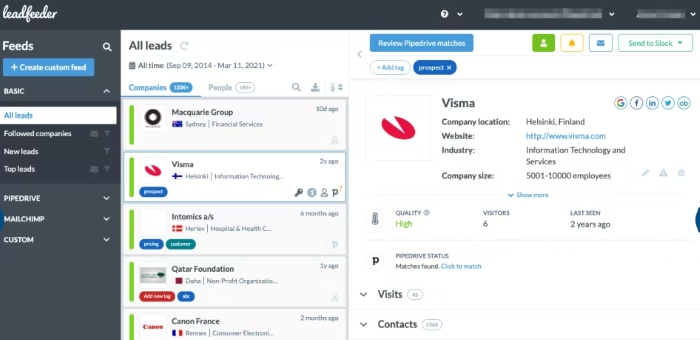
ZoomInfo Website Chat & Visitor Tracking: Integrated B2B Intelligence
Evaluation Methodology: Our team conducted a demo focusing on ZoomInfo’s visitor tracking and chat features within their sales intelligence platform. We tested real-time company identification, automated enrichment, and chat engagement workflows. Findings were cross-checked with G2 (4.3/5) and Capterra (4.4/5) reviews to validate user experiences for mid-market and enterprise B2B teams.
Key Features & Unique Selling Points
Integrated Visitor Tracking & Chat – Combines real-time identification of company visitors with on-site chat for immediate engagement.
Extensive B2B Database – Leverages ZoomInfo’s firmographic and contact data for seamless lead enrichment.
Automated Lead Enrichment – Visitor activity is automatically linked to company and contact profiles within ZoomInfo.
Sales Intelligence Integration – Directly connects visitor insights to ZoomInfo’s prospecting, list-building, and workflow tools.
Ideal Use Cases & Target Audience
Sales and marketing teams already using ZoomInfo for prospecting.
Organizations seeking an all-in-one solution for account intelligence and on-site engagement.
Teams focused on ABM and real-time lead prioritization.
Pros & Cons
Pros:
Deep integration with ZoomInfo’s database and CRM workflows.
Real-time insights allow immediate engagement with high-value visitors.
Cons:
Significant investment if not already a ZoomInfo customer.
Learning curve can be steep for beginners or smaller teams.
Pricing Overview & Free Trial Options
Pricing is customized as part of ZoomInfo’s enterprise suite.
Free trial/demo options are available through ZoomInfo sales representatives.
Expert Insight
"ZoomInfo’s visitor tracking has been a game-changer for our ABM strategy. We can instantly identify target accounts on our site and engage them proactively, which has shortened our sales cycle significantly." – Marketing Manager, B2B SaaS
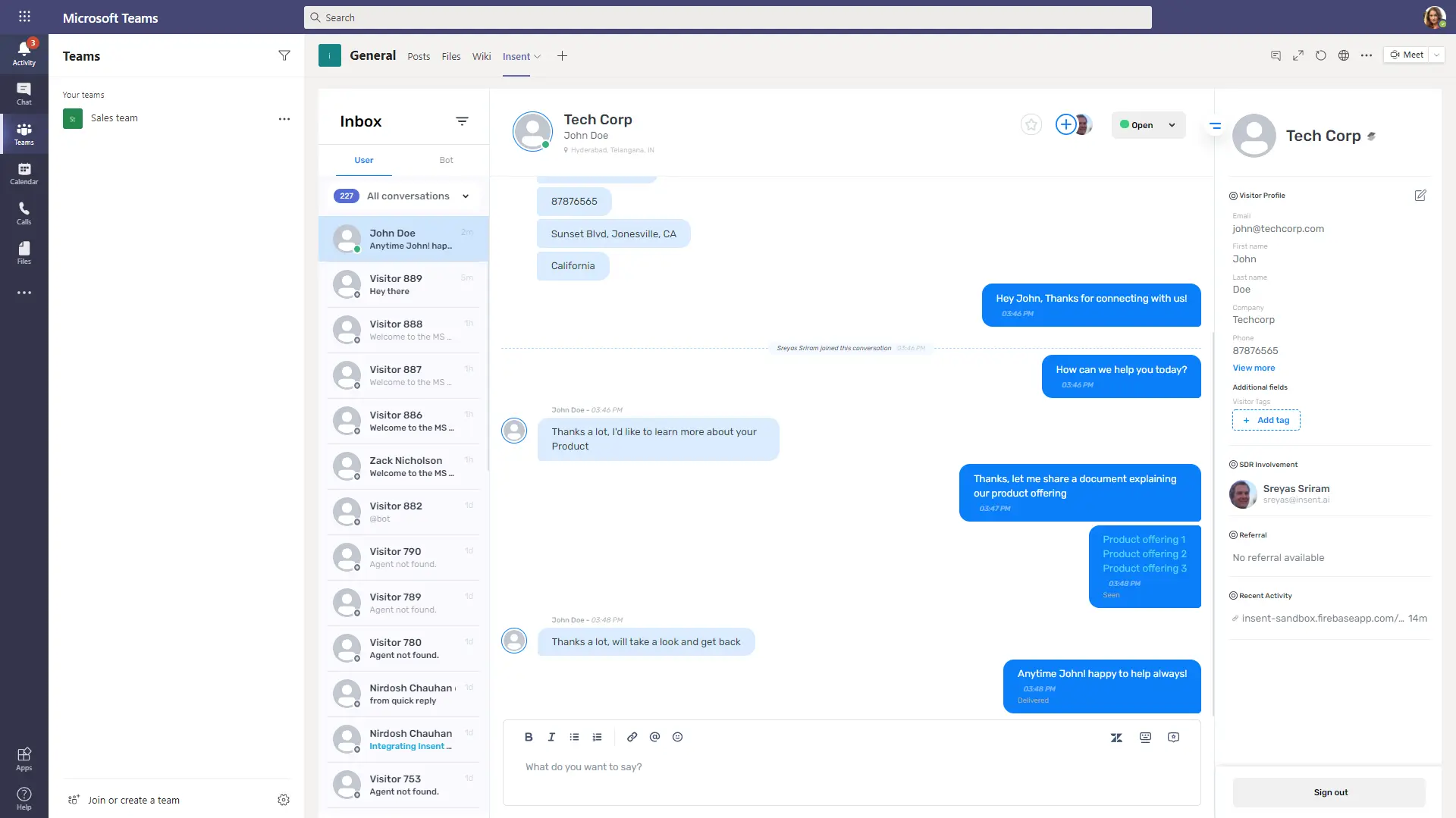
Clearbit Reveal: High-Accuracy Visitor Identification & Enrichment
Evaluation Methodology: We tested Clearbit Reveal using a trial setup focused on IP-to-company mapping, real-time firmographic enrichment, and API integrations. The evaluation emphasized how well the tool powers personalization and data-driven marketing workflows. Insights were validated with G2 (4.5/5) and Capterra (4.6/5) ratings, confirming real-world accuracy and reliability.
Key Features & Unique Selling Points
IP-to-Company Mapping – Identifies anonymous website visitors and links them to their organizations.
Real-Time Firmographic Enrichment – Adds industry, size, location, and revenue data instantly.
Marketing Automation Integrations – Connects with platforms like HubSpot, Marketo, and Salesforce to enable personalized campaigns.
API-First Approach – Supports custom integrations for teams with development resources, enabling tailored workflows and automated data flows.
Ideal Use Cases & Target Audience
Companies focused on website personalization and targeted ABM campaigns.
Organizations seeking accurate, real-time enrichment for lead scoring and segmentation.
Teams with strong development capabilities aiming for custom integrations and automation.
Pros & Cons
Pros:
Highly accurate company and firmographic data.
Powerful API for custom workflows and integrations.
Ideal for personalizing website content and campaigns.
Cons:
Less of a standalone “dashboard” tool often paired with other Clearbit products.
Higher pricing compared to simpler visitor tracking solutions.
Requires technical resources for full API utilization.
Pricing Overview & Free Trial Options
Pricing is customized, frequently bundled with other Clearbit products.
Trial or demo options available via Clearbit sales representatives.
Expert Insight
"Clearbit Reveal’s firmographic data is exceptionally accurate. It allows our RevOps team to enrich leads in real time and prioritize accounts with confidence shortening sales cycles and improving conversion rates." – RevOps Manager, B2B Technology.
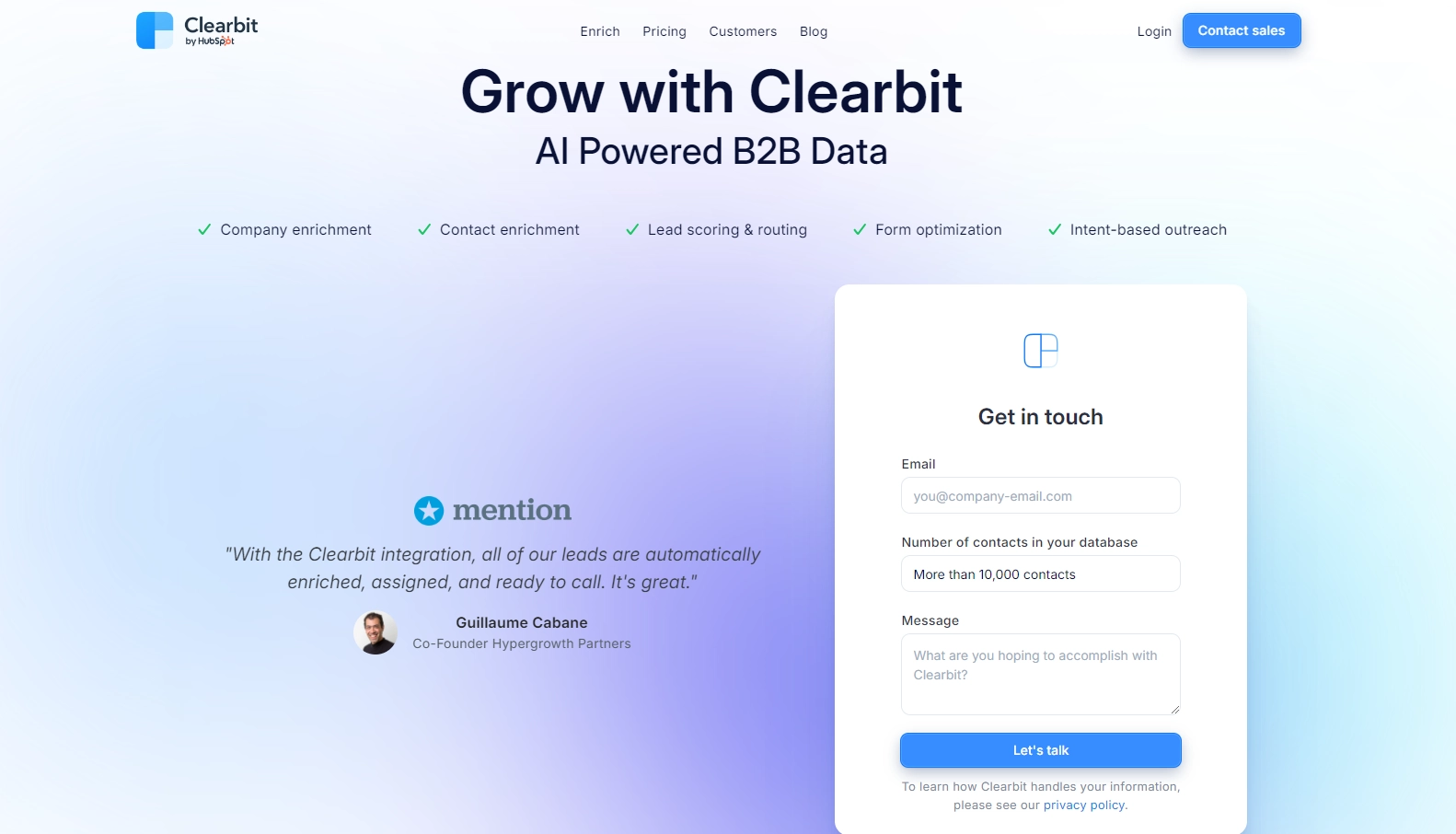
Factors.ai: Revenue-Focused Visitor Tracking & Analytics
Evaluation Methodology: We conducted a hands-on demo of Factors.ai, testing IP-based visitor identification, firmographic enrichment, behavioral analytics, and dashboard customization. The focus was on linking website activity to revenue outcomes and evaluating integration with CRMs and ad platforms. Reviews from G2 (4.4/5) and Capterra (4.5/5) were consulted to confirm performance claims and usability.
Key Features & Unique Selling Points
Comprehensive B2B Analytics – Combines visitor tracking with revenue attribution, connecting site activity directly to pipeline outcomes.
IP-Based Identification & Enrichment – Maps anonymous visitors to companies with detailed firmographic and behavioral insights.
Advanced Reporting & Dashboards – Customizable analytics for sales, marketing, and RevOps teams to monitor performance and engagement trends.
CRM & Ad Platform Integrations – Syncs visitor insights with Salesforce, HubSpot, and advertising platforms for actionable campaigns.
Ideal Use Cases & Target Audience
Data-driven marketing and sales teams looking to optimize campaigns based on visitor activity.
Companies that want to directly correlate website behavior with revenue impact.
Organizations needing detailed dashboards and attribution analytics for decision-making and forecasting.
Pros & Cons
Pros:
Strong focus on revenue attribution and measurable ROI.
Deep analytics for visitor behavior and account engagement.
Highly customizable dashboards for team-specific insights.
Cons:
Broader platform may be more than what teams need if looking only for basic visitor tracking.
Steeper learning curve due to advanced analytics features.
Pricing Overview & Free Trial Options
Custom pricing based on usage and required features.
Trial or demo available via Factors.ai sales team.
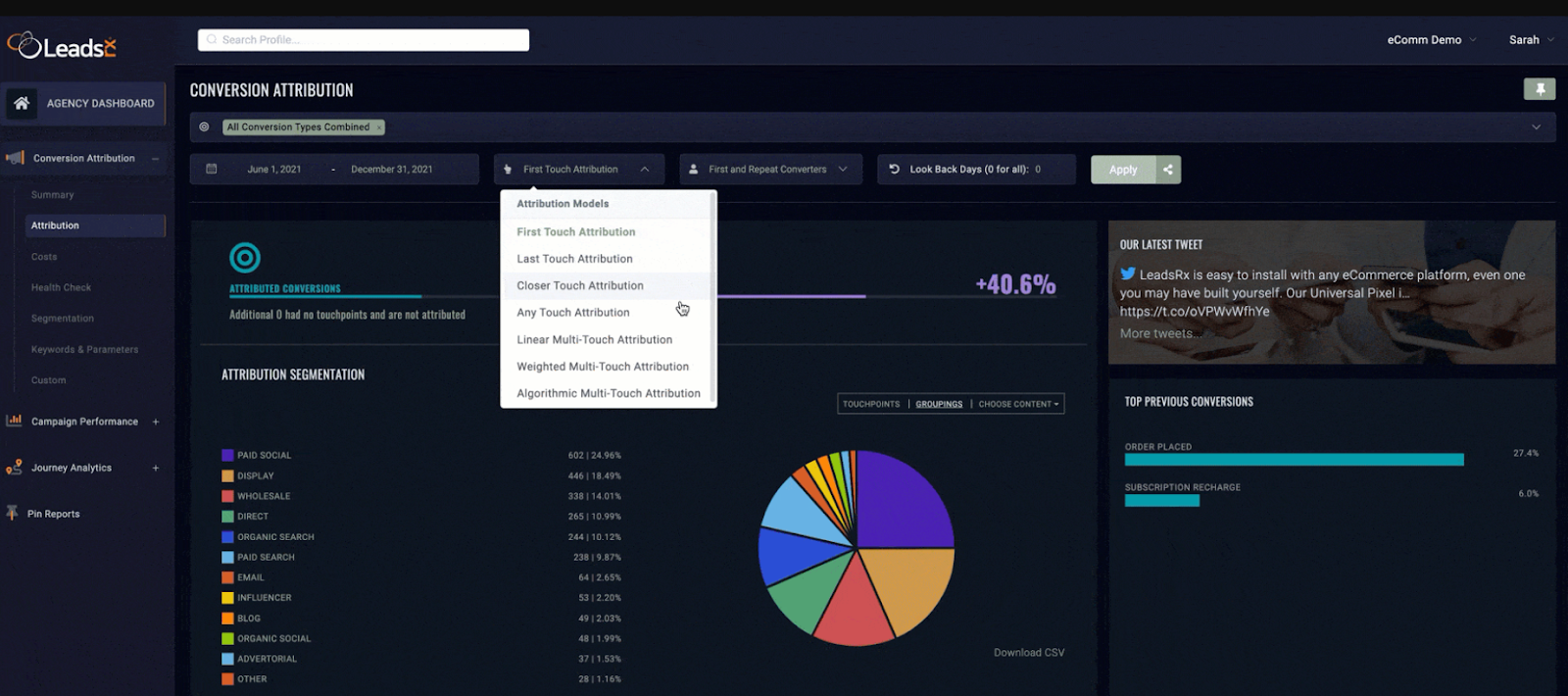
Outfunnel: Simple, CRM-Centric Visitor Tracking
Evaluation Methodology: We tested Outfunnel through a 14-day free trial, focusing on website visitor identification, CRM syncing, and email engagement tracking. The evaluation emphasized ease of use for small to mid-sized sales teams and seamless integration with HubSpot and Pipedrive. Ratings from G2 (4.6/5) and Capterra (4.7/5) confirm its strong usability and value for SMBs.
Key Features & Unique Selling Points
·CRM-Centric Integrations – Automatically syncs visitor data with HubSpot or Pipedrive for seamless sales activation.
·Website Visitor Identification – Converts anonymous traffic into actionable account and contact insights.
·Email Engagement Connection – Combines web activity with email opens, clicks, and engagement for a complete view of prospect interest.
·Simplicity & Ease of Use – Minimal setup and intuitive interface, ideal for teams without dedicated technical resources.
Ideal Use Cases & Target Audience
Small to medium-sized B2B companies seeking tight CRM integration.
Sales teams prioritizing streamlined workflows and immediate actionability of visitor data.
Organizations wanting a holistic view of account engagement across website and email.
Pros & Cons
Pros:
Excellent CRM integration and automated syncing.
Quick to set up with a user-friendly interface.
Good value for SMBs needing actionable visitor insights.
Cons:
Less advanced intent data compared to specialized ABM or analytics platforms.
Pricing Overview & Free Trial Options
Tiered pricing based on number of contacts tracked.
Free trial available for testing core features.
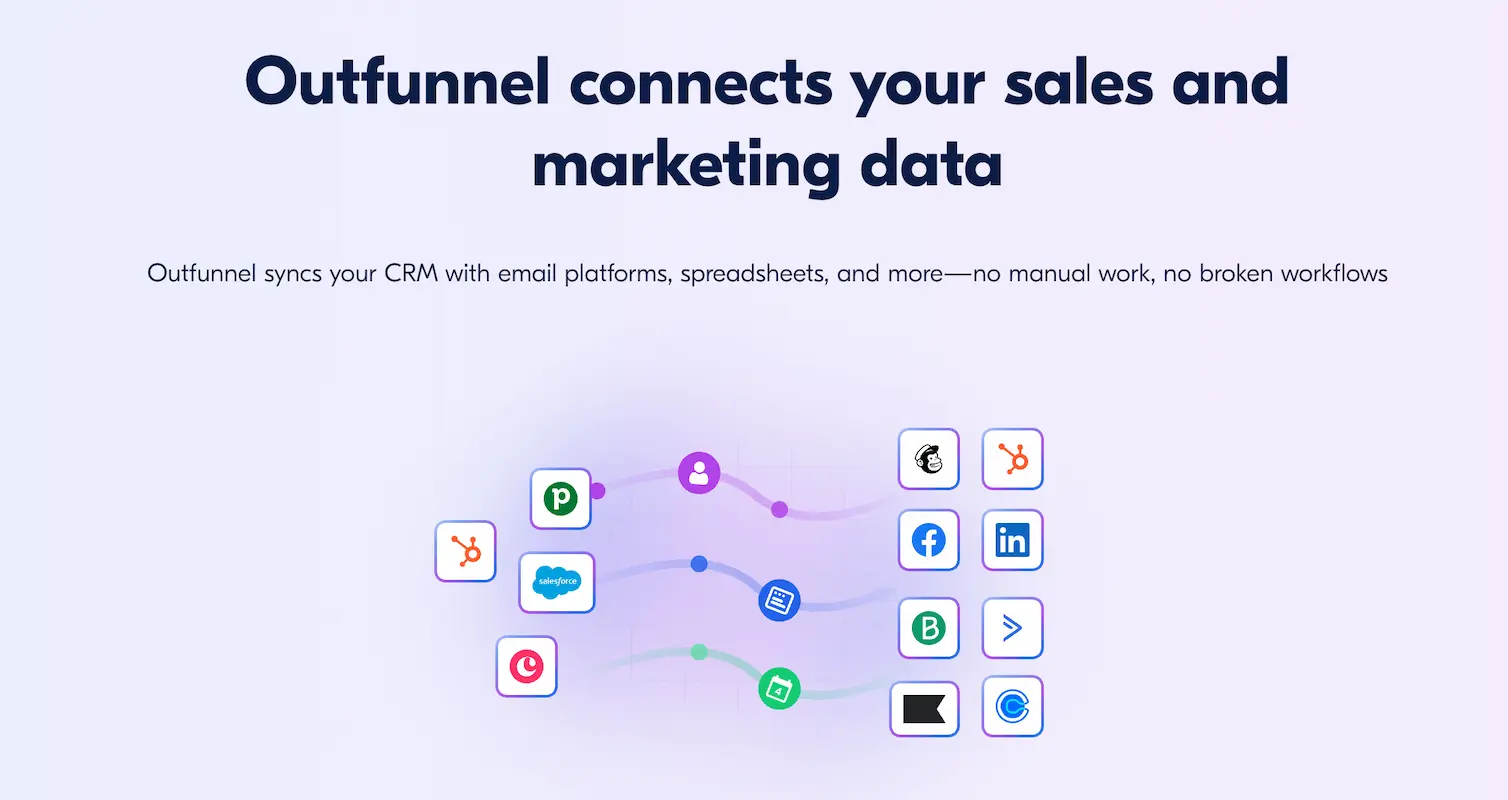
Warmly: Real-Time Visitor Insights for Sales Engagement
Evaluation Methodology: We tested Warmly using a trial account, focusing on its real-time visitor identification, LinkedIn integration, and video conferencing features. Our assessment evaluated how quickly sales reps can access company insights during virtual meetings and personalize outreach. User feedback from G2 (4.5/5) and Capterra (4.6/5) confirms strong adoption among sales teams seeking real-time intelligence.
Key Features & Unique Selling Points
·Real-Time Visitor Identification – Instantly identifies companies visiting your website or engaging in digital touchpoints.
·Company & LinkedIn Insights – Provides instant firmographic details and key contacts for personalized engagement.
·Video Conferencing Integration – Works with Zoom and Google Meet to enrich meetings with visitor data and context.
·Digital Business Card – Facilitates personalized follow-ups and improves connection rates.
Ideal Use Cases & Target Audience
·Sales teams engaging in virtual meetings and online demos.
·Organizations seeking real-time, actionable account intelligence for sales enablement.
·Teams focused on personalized outreach and improving virtual engagement success.
Pros & Cons
Pros:
·Real-time insights enhance sales responsiveness.
·Unique integration with video conferencing tools.
·Strong support for personalized outreach during meetings.
Cons:
·Primarily sales-focused; limited marketing attribution or ABM capabilities.
·Less robust for revenue analytics or long-term visitor behavior tracking.
Pricing Overview & Free Trial Options
·Tiered pricing based on features and usage.
·Free version available with basic visitor identification and insights.
Visual suggestion: Screenshot of Warmly’s meeting overlay showing company insights and LinkedIn data.
If you like, I can now draft the final “Comparison & Recommendations” section, including a side-by-side table, key differentiato
Albacross: Visitor Identification & ABM-Focused Insights
Evaluation Methodology: We conducted a hands-on trial of Albacross, testing website visitor identification, lead scoring, ABM features, and CRM/marketing automation integrations. Our review focused on how effectively the platform surfaces high-value accounts and supports account-based campaigns. Ratings from G2 (4.3/5) and Capterra (4.4/5) confirm strong performance in lead generation and ABM use cases.
Key Features & Unique Selling Points
Website Visitor Identification – Maps anonymous visitors to company profiles with firmographic details.
Account-Based Marketing Features – Supports ABM campaigns with account scoring and prioritization.
Lead Scoring & Email Alerts – Notifies sales teams of high-intent visitors for timely follow-up.
CRM & Marketing Automation Integrations – Connects with major platforms for seamless workflow execution.
Ideal Use Cases & Target Audience
B2B companies of all sizes aiming to identify and prioritize website visitors.
Sales and marketing teams executing ABM strategies.
Organizations seeking timely alerts and account scoring to accelerate sales cycles.
Pros & Cons
Pros:
Robust company identification and enrichment.
ABM-focused features enhance account targeting and prioritization.
Integrates with popular CRM and marketing platforms.
Cons:
Interface may be less intuitive for some users.
Pricing can increase quickly with higher website traffic.
Pricing Overview & Free Trial Options
Tiered pricing, with custom quotes available based on company size and traffic. Free trial available for testing core features.
Side-by-Side Comparison: Top B2B Visitor Tracking Tools
Here’s a concise, actionable comparison of the leading B2B website visitor tracking tools for 2024. This table highlights key features, primary use cases, integrations, pricing, trial options, and strengths/limitations, helping sales and marketing leaders quickly assess the right fit.
Expert Tip: When evaluating these tools:
1.Align with your tech stack: Prioritize platforms that integrate seamlessly with your CRM and marketing automation systems.
2.Define your ICP: Ensure the tool’s identification and enrichment features match your target accounts.
3.Consider scale and ROI: For smaller teams, simpler tools like Outfunnel or Warmly may provide quick wins, whereas enterprise teams may benefit from ZoomInfo or Factors.ai for deeper analytics and ABM support.
This table provides a quick snapshot to guide decision-making for B2B teams looking to convert anonymous traffic into actionable leads in 2024.
Strategic Advantage: Leveraging Visitor Tracking for Your B2B Teams
Visitor tracking is more than just data it’s a strategic lever that enables sales and marketing teams to act with precision, personalize interactions, and drive measurable revenue growth. Real-world examples demonstrate how these tools move the needle beyond generic benefits.
For Sales Teams: Prioritization, Personalization, Proactive Outreach
1. Identifying Hot Leads
Visitor tracking tools allow sales reps to pinpoint accounts exhibiting high buying intent, such as repeated visits to pricing pages, product demos, or downloadable content. This shifts outreach from reactive to proactive, focusing efforts on prospects most likely to convert.
2. Tailored Conversations
Armed with insight into which pages or resources a prospect consumed, sales teams can craft personalized messaging that references those interactions. Mentioning specific content or solutions visited signals attentiveness and builds credibility with potential buyers.
3. Timing is Everything
Real-time alerts from visitor tracking platforms ensure sales teams reach out at the moment prospects are actively engaged, increasing the likelihood of positive responses and faster deal progression.
Micro-Case Study Example
A mid-market B2B SaaS company used a visitor tracking tool to identify a competitor’s customer browsing their pricing comparison page. The sales team received a real-time alert and quickly initiated a personalized outreach referencing the competitor’s offering and the prospect’s interests. This led to a successful demo and conversion, illustrating the power of timely, informed engagement.
For Marketing Teams: Campaign Optimization, Content Strategy, Website Personalization
Visitor tracking empowers marketing teams to move beyond vanity metrics like clicks and pageviews, giving actionable insight into qualified company engagement.
1. Measuring Campaign Effectiveness
By identifying which campaigns attract the most high-value company traffic, marketers can optimize budget allocation, messaging, and channel strategies for measurable ROI.
2. Content Gap Analysis
Tracking which pages and resources are being consumed reveals content gaps topics your target companies are searching for but not finding allowing for smarter content creation.
3. Dynamic Website Content
Leverage visitor identification to create personalized website experiences. For example, display industry-specific case studies or tailored CTAs for returning company visitors, boosting engagement and conversion.
Micro-Case Study Example
An industrial supplier observed that companies in the manufacturing sector frequently visited a specific product category. Using these insights, they launched a targeted email nurture series and updated website banners for that segment, resulting in a measurable increase in demo requests and qualified leads.
For RevOps Professionals: Funnel Optimization, Data Governance, ROI Measurement
Visitor tracking also gives Revenue Operations teams the visibility and control they need to optimize processes and demonstrate measurable impact.
1. Pipeline Visibility
Identify previously anonymous stages in the sales funnel, giving a complete picture of account engagement and helping forecast pipeline health more accurately.
2. Data Quality & Enrichment
Ensure visitor data flows seamlessly into CRM and marketing systems, enriching existing records and providing clean, actionable data for downstream processes.
3. Attribution Insights
Connect website behavior directly to revenue outcomes, proving the ROI of marketing campaigns and sales outreach and justifying budget allocation.
Micro-Case Study Example
A RevOps team integrated visitor tracking data with their CRM, enabling automated lead routing. High-intent accounts were immediately assigned to the appropriate sales rep, reducing response time by 30% and improving conversion velocity.
Making the Right Choice: A Buyer's Guide for Your Business
Selecting the right B2B website visitor tracking tool can feel overwhelming. With dozens of options, varying feature sets, and differing pricing models, it’s easy to get lost. This guide helps you cut through the noise and choose a solution that aligns with your company size, goals, and tech stack.
Assessing Your Needs: Company Size, Budget, & Goals
1. Small Business / Startup
Focus on core identification features, ease of use, and budget-friendly pricing.
Tools like Outfunnel or Warmly are ideal for quick setup and actionable insights without heavy technical resources.
2. Mid-Market
Look for robust CRM integrations, lead scoring, visitor enrichment, and solid reporting dashboards.
Tools such as Leadfeeder or Clearbit Reveal strike a balance between functionality and usability for growing teams.
3. Enterprise
Prioritize advanced analytics, custom integrations, ABM capabilities, and scalable support.
Platforms like ZoomInfo or Factors.ai offer the depth, automation, and white-glove support required for large, complex operations.
Defining Your Goals
Are you primarily aiming for sales lead generation, marketing personalization, or a blend of both?
Match tool capabilities to these goals: sales-heavy teams benefit from real-time alerts and ABM features, while marketing-focused teams benefit from dynamic personalization and campaign insights.
Integrating with Your Existing Tech Stack
1. CRM is King
Native, deep integrations with your primary CRM Salesforce, HubSpot, Pipedrive, Zoho, or Microsoft Dynamics ensure smooth workflows and prevent data silos.
2. Marketing Automation Compatibility
Ensure the tool works with your marketing automation platform Marketo, Pardot, ActiveCampaign, Mailchimp to enable personalized campaigns and automated workflows.
3. Sales Enablement Tools
Consider integrations with tools like Outreach, Salesloft, or other engagement platforms to fully leverage visitor insights during outreach.
Expert Tip: Start with your CRM. Prioritize tools offering robust native integrations to ensure seamless data flow across your sales and marketing teams, maximizing the impact of visitor tracking data.
Prioritizing Features: What Matters Most for Your Strategy
When evaluating B2B website visitor tracking tools, not all features carry the same weight. Focusing on what directly drives your business goals ensures you select a solution that delivers ROI without unnecessary complexity.
Must-Have Features
These are non-negotiable capabilities based on core use cases:
IP Lookup & Company Identification – The foundation for converting anonymous traffic into actionable leads.
CRM Integration – Native connections with your primary CRM (Salesforce, HubSpot, Pipedrive) for seamless workflow and lead management.
Real-Time Alerts – Notifications for high-intent visitors to enable timely outreach and maximize conversion opportunities.
Firmographic Data Enrichment – Key company information such as industry, size, location, and revenue to qualify accounts quickly.
Nice-to-Have Features
These enhance capabilities and provide competitive advantages but may not be immediately essential:
Advanced Intent Data – Insights into visitor research patterns and content interest to prioritize leads more intelligently.
Predictive Analytics – Scoring models that forecast which accounts are most likely to convert.
Website Personalization – Dynamic content adjustments for returning or high-value company visitors.
Integration with Marketing Automation & Sales Engagement Platforms – For multi-channel workflows and campaign optimization.
Ease of Use vs. Advanced Functionality
Balance is key: Powerful features are only valuable if your team can leverage them effectively.
For small teams, prioritize intuitive tools with core functionality and minimal setup (e.g., Outfunnel, Warmly).
For mid-market or enterprise teams, advanced analytics and ABM capabilities (e.g., Factors.ai, ZoomInfo) may justify a steeper learning curve.
Ethical Tracking & Data Privacy: Navigating Compliance
Website visitor tracking provides powerful insights, but it also raises legitimate concerns about privacy and regulatory compliance. B2B teams must balance actionable intelligence with responsible data practices.
Understanding GDPR, CCPA, and Other Regulations
1. Overview
GDPR (General Data Protection Regulation) applies to visitors from the European Union.
CCPA (California Consumer Privacy Act) governs personal data of California residents.
Both regulations are relevant because website visitor tracking may involve collecting user behavior or identifying information.
2. Key Principles
Consent: Obtain clear permission where required.
Data Minimization: Only collect what is necessary.
Transparency: Explain how data is used and stored.
Data Subject Rights: Ensure users can access, correct, or request deletion of their data.
3. Company vs. Individual Data
B2B visitor tracking primarily identifies companies, not individuals.
If any PII (Personally Identifiable Information) is captured, regulatory obligations apply.
Expert Tip: Choose tools that support GDPR and CCPA compliance, offering consent management, anonymization, and robust security features.
Best Practices for Ethical Data Collection
1.Transparency – Clearly describe your data collection practices in your privacy policy.
2.Consent Mechanisms – Implement cookie banners or consent management platforms where required.
3.Data Minimization Collect only the information necessary to achieve your stated objectives.
4.Security Ensure both the platform and your internal processes safeguard collected data from unauthorized access.
Common Questions: FAQs About B2B Website Visitor Tracking
How accurate are B2B website visitor tracking tools?
Answer: Discuss factors influencing accuracy (IP database quality, VPN usage, mobile traffic) and generally how reliable they are for identifying companies.
Is B2B website visitor tracking legal and GDPR/CCPA compliant?
Answer: Reiterate that identifying companies (IP to firmographic data) is generally compliant, but emphasize the need for transparency, consent for personal data, and adherence to privacy policies.
How quickly can I see results after implementing a tool?
Answer: Explain that identification starts immediately, but actionable results (e.g., qualified leads, improved conversions) depend on integration, team alignment, and strategic use, typically visible within weeks to a few months.
What's the difference between B2B and B2C website tracking?
Answer: Clarify that B2B focuses on identifying companies and enriching with firmographic data, while B2C often focuses on individual user behavior, demographics, and personalization for consumers.
Can these tools identify individuals, not just companies?
Answer: Explain that the primary function is company identification. Individual identification typically requires specific login data, form submissions, or integrations with tools like Leadfeeder Contacts (which links to public professional profiles).
How do these tools integrate with my CRM?
Answer: Detail typical integration methods: native connectors, API integrations, and webhook support for automated data sync and workflow triggers.
Conclusion Empowering Your B2B Growth with Data-Driven Insights
B2B website visitor tracking tools are no longer optional they are strategic assets that turn anonymous traffic into actionable intelligence. By identifying which companies are engaging with your website, sales teams can prioritize high-intent leads, marketing teams can deliver personalized experiences, and RevOps can measure the true ROI of campaigns.
