
Sales Funnels for Coaches Convert Leads to Clients
Is Your Coaching Business Predictable or Random?
Is your coaching business relying on referrals and inconsistent DMs or do you have a predictable system that turns complete strangers into high-paying clients every single month? For many coaches, growth feels uncertain. One month is fully booked. The next month is quiet. Leads show interest, download free content, attend webinars but never convert. You post consistently, nurture your audience, and respond to inquiries manually… yet revenue still feels unstable. If that sounds familiar, you’re not alone.
No System, No Predictability
Most coaches struggle with:
Unpredictable income that makes scaling risky
Leads who say they’re “interested” but never take action
Publishing endless content without measurable conversions
Spending hours in manual follow-ups, reminders, and DMs
Here’s the hard truth: content alone is not a system.
Without a structured sales funnel, your marketing depends on hope hope that someone sees your post, hope that they reach out, hope that they’re ready to buy. That approach creates burnout, not scale. A coaching business cannot grow sustainably without a predictable client acquisition process. And that’s exactly what a sales funnel provides.
A Scalable Sales Funnel Framework
A high-converting sales funnel transforms your business from reactive to systematic.
Instead of chasing leads, your funnel:
Attracts qualified prospects automatically
Nurtures them with strategic messaging
Pre-qualifies them before sales conversations
Converts them into paying clients
Maximizes lifetime value through retention and upsells
This guide will walk you step-by-step through building a sales funnel designed specifically for coaches, consultants, and service-based experts.
You’ll learn:
The most effective funnel types for coaching offers
How to structure each stage from awareness to retention
The tools and automation systems that save time and increase efficiency
Key metrics to track for measurable growth
Optimization tactics that improve conversion rates
By the end of this guide, you won’t just understand what a sales funnel is you’ll know how to build one that creates predictable revenue and scalable growth.
Understanding the “Why”: Core Problems Sales Funnels Solve for Coaches
The Challenge: Growth Based on Referrals and Random Visibility
Many coaches build their businesses on referrals, organic social posts, and word-of-mouth marketing. While these channels can generate high-quality clients, they are inherently unpredictable.
You might have a strong month when a past client refers two people. The next month, nothing happens. You post consistently on Instagram or LinkedIn, but reach fluctuates. Algorithms change. Engagement drops. Inquiries slow down.
This creates a fragile growth model. If your client acquisition depends on people “finding you,” you don’t have a system you have exposure.
Revenue Fluctuates Month to Month
Unstable lead flow leads directly to unstable income.
One month: fully booked calendar
Next month: empty strategy calls
No reliable forecast of revenue
Difficulty planning hiring, ads, or scaling
For coaches offering high-ticket services, even a small dip in booked calls can significantly impact monthly revenue. This unpredictability creates stress and limits long-term strategic decisions. You can’t confidently invest in paid traffic, team members, or new offers if you don’t know where your next clients are coming from.
Automated, Predictable Lead Generation
A structured sales funnel replaces randomness with predictability.
Instead of waiting for inquiries, you proactively generate leads through:
Paid traffic (Meta, Google, YouTube ads) targeting your ideal client
High-value lead magnets that solve a specific, urgent problem
Dedicated landing pages optimized for conversions
Here’s how the system works:
Traffic is driven to a focused landing page.
Visitors exchange their email for a valuable resource (guide, checklist, quiz, webinar).
They enter your nurture sequence automatically.
You track cost per lead, opt-in rate, and booking rate.
Now you can measure performance.
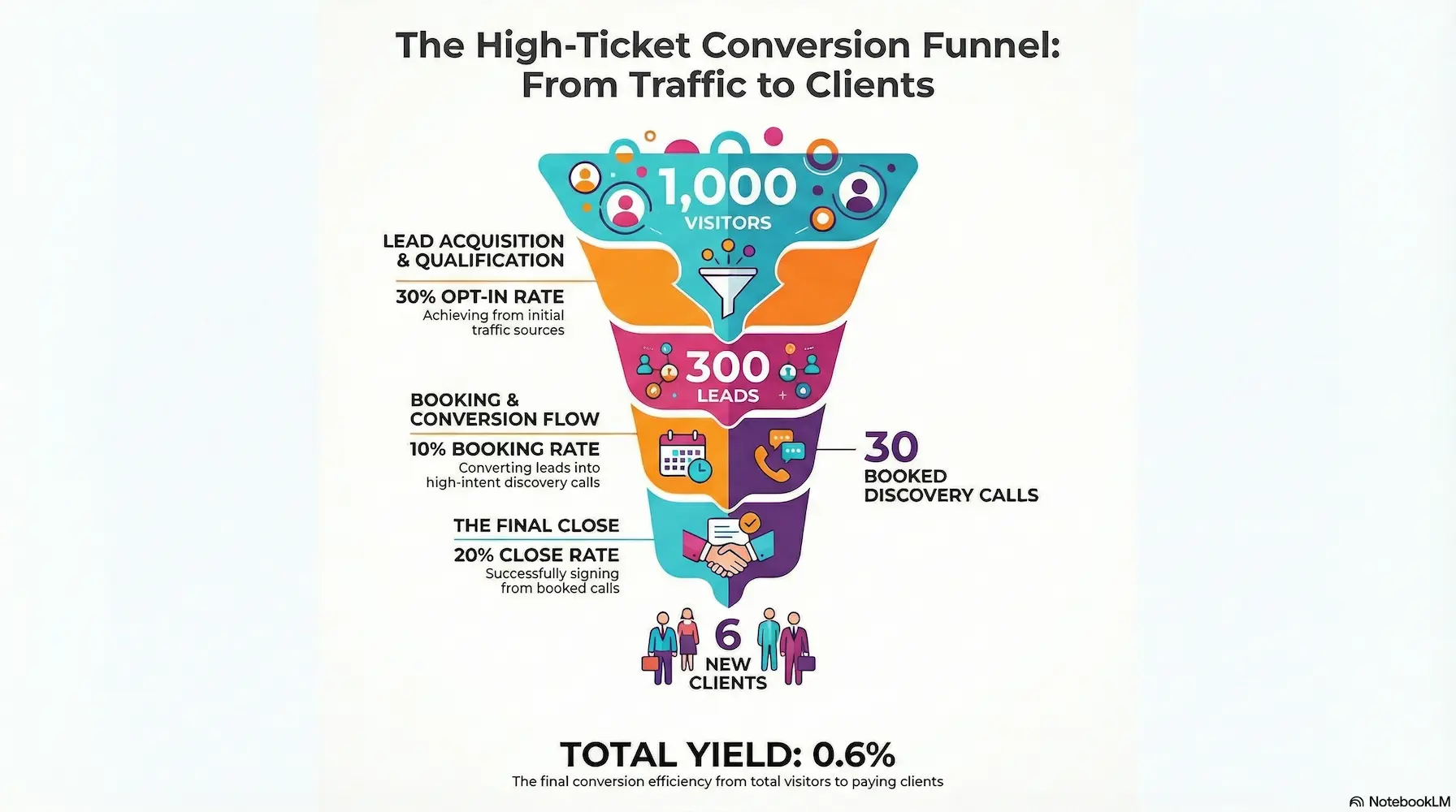
That’s not guesswork that’s a system.
Once you understand your numbers, scaling becomes mathematical. Increase traffic, optimize conversion rates, and revenue grows predictably.
For coaches who want to automate and scale client acquisition, consistent lead flow is not optional. It is the foundation. And a properly built funnel makes it achievable.
Low Conversion from Leads to Clients
The Challenge: Engagement Without Action
Many coaches generate leads successfully people download the free guide, attend the webinar, follow on Instagram, and open emails.
But they don’t book calls.
Your audience is consuming your content, reacting to posts, even replying to emails yet when it’s time to take the next step, momentum disappears.
This creates a frustrating gap between attention and revenue.
Engagement feels good.
Sales pay the bills.
High Engagement, Low Sales
Here’s what this often looks like:
500 new leads added to your list
40–50% email open rates
Webinar attendance numbers look promising
But only 2–3 sales
For coaches, this signals a conversion breakdown not a traffic problem.
Without structured nurturing, leads stay in “interested” mode instead of moving into “decision” mode.
When there’s no strategic progression:
Prospects stay stuck in research mode
Objections go unaddressed
Authority isn’t reinforced
Urgency isn’t created
The next step isn’t clearly positioned
As a result, leads go cold.
The Funnel Solution Structured Nurture & Strategic Conversion Path
A high-converting funnel doesn’t just collect emails it guides prospects toward a buying decision.
Here’s how:
1. Structured Nurture Sequences
Instead of random emails, you implement a deliberate sequence:
Email 1: Quick win + credibility
Email 2: Story + transformation case study
Email 3: Objection handling
Email 4: Authority positioning
Email 5: Strategic invitation to book a call
Each email has a purpose. Each message moves the prospect one step closer to commitment.
This creates psychological progression instead of passive consumption.
2. Authority-Building Content
Prospects invest when they trust your expertise.
Authority-building emails should include:
Client results and case studies
Framework explanations
Behind-the-scenes strategy
Clear positioning of your unique method
When leads understand why your approach works, they stop comparing you purely on price.
3. Strategic Call Booking Pages
Many coaches lose conversions at the booking stage.
Common mistakes:
Generic Calendly link with no context
No pre-framing of call expectations
No qualification filter
A strategic booking page should:
Reinforce the transformation
Clarify who the call is for
Pre-handle objections
Set expectations
Include testimonials
Qualify applicants
This increases show-up rate and improves close rate.
Measurable Impact
When nurture and booking are optimized, you typically see:
Higher booking rates (5–15% of leads instead of 1–3%)
Improved show-up rates (70–80% with reminders and pre-framing)
Increased close rates due to better pre-qualification
For coaches scaling client acquisition, conversion is leverage.
You don’t always need more traffic.
You need a better system that turns the traffic you already have into paying clients.
Manual Follow-Up & Time Drain
The Challenge: Chasing Leads Instead of Coaching
Many coaches spend hours every day replying to DMs, sending reminder messages, and manually following up with interested prospects. While this personal touch can convert some clients, it quickly becomes exhausting. Over time, the effort needed to maintain consistency grows, and your coaching time the work that actually generates revenue suffers. When every new lead requires manual attention, scaling your business becomes nearly impossible.
Burnout and Limited Scalability
The result is predictable:
Long workdays filled with repetitive tasks
Missed follow-ups due to human error or overwhelm
Inconsistent communication, frustrating prospects
Limited capacity to onboard more clients without hiring additional help
This creates a ceiling on your business growth. You might be able to handle 5–10 clients manually, but any more leads overwhelm your system. Without automation, growth is directly tied to your personal effort and that’s not sustainable.
The Funnel Solution: Automation to Free Your Time
A well-designed sales funnel solves this problem with three core systems:
Email Automation
Automatically nurture leads with pre-written sequences
Send value-packed emails, handle objections, and position calls to action
Leads progress without manual intervention
Booking Automation
Schedule strategy calls automatically using tools like Calendly or Acuity
Integrate with your CRM to avoid double-booking and send automated reminders
Pre-qualify prospects before the call
CRM Tracking
Organize leads by stage in the funnel
Track engagement, call outcomes, and follow-ups
Gain insights into conversion rates and pipeline health
Real-World Benefit
By automating follow-ups:
You reduce daily administrative tasks by 50–70%
Lead response becomes immediate, increasing booking rates
Your business can scale without adding hours to your schedule
Burnout is minimized, freeing you to focus on delivering transformation
Automation doesn’t remove the human element it amplifies it. You can respond personally where it matters, while letting the system handle repetitive tasks. For coaches ready to scale, automation is no longer optional; it’s essential.
Difficulty Positioning Premium Offers Selling High-Ticket Coaching
Many coaches struggle to justify premium pricing for their services. You know your transformation is worth $2K–$10K+, but prospects often push back or hesitate. Without a clear system to demonstrate value, you end up discounting your services, attracting price-sensitive clients, and leaving revenue on the table. The result? High effort, low reward, and frustration as your expertise goes undervalued.
Attracting the Wrong Clients
Selling premium coaching isn’t just about price it’s about perception and positioning. Common problems include:
Prospects comparing your offer to cheaper alternatives
Leads questioning ROI or impact
High-ticket clients slipping through the funnel because they don’t see the transformation
Time wasted on negotiations and objections
If your funnel doesn’t educate and nurture prospects toward seeing your premium value, conversions drop even if you have strong leads.
The Funnel Solution: Structured Value & Authority
To sell premium coaching effectively, your funnel should include:
Value Ladder Strategy
Start with a low-cost or free offering (lead magnet, challenge, mini-course)
Gradually introduce higher-ticket offers as trust and credibility grow
Helps prospects experience transformation before investing in your premium program
Authority-Driven Nurture Content
Share client results, case studies, and success stories
Demonstrate frameworks, methods, and processes unique to your coaching
Build credibility and reinforce the value of your premium offer
Webinar Funnels for High-Ticket Sales
Host educational webinars that deliver actionable content while pre-selling your premium coaching
Address objections live and showcase real transformation
Position your offer as the natural next step for attendees
Real-World Benefit
A well-structured premium funnel can transform your client acquisition process:
Attract high-value leads who understand and are willing to pay for results
Increase close rates on high-ticket offers
Reduce time spent convincing skeptical prospects
Position you as an authority in your niche
By combining a value ladder, nurturing content, and strategic webinars, you move prospects from “interested” to “ready to invest” seamlessly without compromising your pricing or burning out on manual persuasion. Premium clients no longer feel like a hard sell they feel like the next logical step in their journey.
No Clear Metrics or Predictability
The Challenge: Flying Blind Without Data
Many coaches run their funnels without tracking meaningful metrics. You might know how many leads signed up for your free guide, or how many people attended your webinar, but beyond that, there’s little clarity on what’s actually driving revenue. Without measurable insights, scaling becomes guesswork. You’re making decisions based on assumptions instead of results increasing risk and wasting time, money, and effort.
Scaling Feels Risky
When key metrics aren’t tracked, you face multiple challenges:
Unsure which traffic source brings the best clients
No visibility into where leads drop off in your funnel
Hard to calculate true ROI of ads, webinars, or email campaigns
Scaling paid campaigns feels like gambling rather than a calculated investment
This lack of predictability prevents coaches from confidently investing in growth. Every new campaign or ad spend carries uncertainty.
The Funnel Solution: Stage-Based KPI Tracking
A high-converting coaching funnel requires clear, measurable KPIs for each stage of the client journey:
Cost per Lead (CPL)
Track how much you spend to acquire each new prospect
Identify the most efficient traffic sources
Show-Up Rate
Measure the percentage of booked calls, webinar attendees, or challenge participants who actually show up
Adjust reminders, confirmation sequences, or pre-call content to improve attendance
Close Rate
Calculate the percentage of prospects who convert into paying clients
Highlight bottlenecks in your sales conversations or funnel messaging
Lifetime Value (LTV)
Track revenue generated per client over time
Optimize upsells, retention programs, and follow-on offers
By implementing stage-based tracking, you can identify weak points, refine messaging, and double down on what works.
Stage 2: Lead Capture (Turning Traffic into Prospects)
Once you’ve attracted traffic, the next critical step is capturing leads turning interested visitors into actionable prospects. Without an effective lead capture system, all your marketing efforts risk going to waste.
Common Lead Capture Methods for Coaches
Free Guide / eBook
Offer a practical resource that solves a specific problem your audience faces
Example: “5-Step Framework to Book Your First 10 High-Paying Clients”
Quiz Funnel
Interactive assessments that provide personalized results
Example: “Which Coaching Strategy Will Grow Your Business Fastest?”
Benefits: Engaging, shareable, and highly effective for segmentation
Webinar Registration
Live or automated webinars that deliver high-value content while pre-selling your coaching offer
Builds authority, trust, and urgency
Free Challenge
Multi-day programs that guide prospects through actionable steps
Encourages commitment and demonstrates your coaching style.
Key Elements of a High-Converting Lead Capture Funnel
High-Converting Landing Page
Focus solely on your offer; avoid distractions
Use persuasive headlines and benefit-driven copy
Clear Transformation Promise
Show exactly what the prospect will gain by opting in
Focus on outcomes, not just features
Simple Opt-In Form
Minimal fields to reduce friction (name + email is usually enough)
Include trust signals (testimonials, privacy assurances)
Stage 3: Nurture (Building Trust & Authority)
After leads enter your funnel, the key is to build trust, demonstrate authority, and guide them toward booking a call or purchasing your coaching program. Without a structured nurture stage, even high-quality leads can go cold.
Why Nurturing Matters
Leads rarely buy on their first interaction. They need repeated exposure to your expertise, proof of results, and reassurance that your coaching will solve their specific problem. A well-structured nurture sequence moves them from passive interest to confident decision-making.
How to Nurture Leads Effectively
1. Email Sequences (5–10 Emails)
Design an automated email series that progressively builds trust and authority:Email 1: Deliver a quick win or actionable tip from your coaching niche. Show your value immediately.
Email 2: Share a compelling client success story with measurable results. Highlight the transformation, not just the process.
Email 3: Handle common objections, such as time, cost, or readiness, through storytelling and examples.
Email 4: Teach a mini-framework or methodology that demonstrates your unique expertise.
Email 5: Extend a strategic invitation to book a call, join a webinar, or enroll in a program.
2. Case Studies
Show real-life examples of clients who achieved significant results. Include metrics, before-and-after scenarios, and testimonials to reinforce credibility. This positions you as an authority and reassures prospects that your coaching delivers results.3. Objection Handling
Anticipate the questions and concerns your leads might have:“Is this worth the investment?”
“Will I get results?”
“Do I have enough time?”
Address these in emails, social posts, and downloadable content. Pre-handled objections reduce friction in the decision-making process.
4. Authority Positioning
Demonstrate your expertise by sharing insights, frameworks, or behind-the-scenes content:Short guides or tip sheets
Video snippets showing your coaching style
Insights into your methodology or approach
Expert Tip: Sell the outcome, not the coaching hours. Prospects are investing in the transformation, not the time spent on sessions. Always frame your content around results, growth, and breakthroughs.
Stage 4: Conversion (Closing the Client)
Once leads are nurtured, the next stage is conversion turning qualified prospects into paying clients. This requires a structured, strategic approach that removes friction, builds urgency, and clearly communicates your value.
High-Converting Conversion Methods
1. Strategy Call Funnel
Discovery or strategy calls are ideal for mid- to high-ticket coaching. Key elements include:
Pre-qualifying leads through forms or applications
Framing the call around the prospect’s transformation, not the sales pitch
Using automated scheduling tools to eliminate back-and-forth
2. Webinar Pitch
Live or automated webinars are powerful for demonstrating your expertise while presenting your premium offer:
Deliver actionable value to participants
Position your coaching as the natural next step
Address objections and answer live questions
3. Application Funnel
For selective programs, application-based funnels increase perceived value and attract high-quality clients:
Filter out unqualified leads
Position your coaching as exclusive and high-value
Encourage applicants to commit mentally before the first call.
Key Optimization Areas for Maximum Results
Show-Up Rate: Send automated reminders, calendar invites, and pre-call preparation guides to ensure attendance.
Call Structure: Follow a consultative approach: diagnose problems, present solutions, and demonstrate ROI.
Offer Positioning: Focus on the transformation your client will achieve, not the coaching hours or features.
Ethical Scarcity: Highlight limited availability or program deadlines to encourage action without pressuring prospects.
Stage 5: Retention & Ascension
A sales funnel doesn’t end when a client says “yes.” The retention and ascension stage focuses on maximizing the value of each client relationship, turning one-time buyers into repeat clients, advocates, and long-term revenue streams. For coaches, this is where your funnel truly scales.
Why Retention & Ascension Matter
Many coaches focus all their energy on acquiring new clients, neglecting the potential of existing ones. By implementing a structured retention and ascension strategy, you:
Increase Lifetime Value (LTV) per client
Build a community of loyal clients
Generate referrals naturally
Reduce the pressure of constantly finding new leads
The principle is simple: it’s far more cost-effective to sell additional services to an existing client than to acquire a new one.
Key Strategies for Retention & Ascension
1. Upsells
Offer complementary or advanced programs after the initial purchase:
Mini-courses, advanced coaching modules, or premium one-on-one sessions
Position upsells as the next logical step in the client’s transformation journey
2. Group Programs
Group coaching or mastermind sessions allow you to serve more clients efficiently:
Provides community and peer accountability
Delivers results at scale
Reduces your one-on-one time while increasing revenue
3. Mastermind Programs
High-ticket mastermind programs create elite communities around your expertise:
Attracts highly motivated clients
Provides networking opportunities and deeper transformation
Solidifies your authority and positioning in your niche
4. Referral Systems
Encourage satisfied clients to bring in new leads:
Offer incentives or recognition for referrals
Turn your best clients into your most effective marketers
Reduce marketing costs while expanding your reach.
Funnels Don’t Stop at the First Sale
Most coaches stop thinking once a client pays. But the real power of a sales funnel lies in maximizing Lifetime Value (LTV). Each client becomes a repeat revenue source, a testimonial, and a potential referrer.
By designing your funnel with retention and ascension in mind, you create a self-reinforcing system where:
Clients continue to grow and invest in higher-value programs
Your income becomes more predictable and scalable
Advocacy and social proof naturally accelerate new lead generation
Best Sales Funnel Types for Coaches (With Use Cases)
Choosing the right funnel type is critical for aligning your offer, audience, and revenue goals. Different funnels serve different purposes from attracting cold leads to closing high-ticket clients. Below is a practical breakdown of the most effective funnels for coaches, along with when and how to use them.
Funnel Builders Building Pages & Checkout Systems
Funnel builders allow coaches to create landing pages, sales pages, opt‑in forms, and checkout systems without coding. These platforms often include drag‑and‑drop editors, templates, and workflow automation essential for designing a seamless client journey.
Examples:
ClickFunnels: Industry standard for conversion‑optimized funnel templates
Systeme.io: All‑in‑one funnel builder with newsletter and membership features
GoHighLevel: Advanced automation platform combining funnels, CRM, and messaging
Best For:
Coaches who want fully integrated funnels with upsells, downsells, and automated responses.
Use Case:
A wellness coach launches a webinar funnel that captures leads, sends automated follow‑ups, and directs prospects to a high‑ticket coaching offer with a seamless checkout experience.
Email Automation Nurture & Follow‑Up at Scale
Email automation platforms help you nurture leads with sequences, tag users based on behavior, and send targeted follow‑ups without manual effort.
Examples:
ActiveCampaign: Powerful segmentation and automation workflows
GetResponse: Email marketing + automation linked with webinars & landing pages
Best For:
Scaling personalized communication across thousands of leads.
Use Case:
After a lead downloads a coaching challenge guide, they’re automatically entered into a 7‑email nurture sequence, each designed to educate, build trust, and lead to a strategy call booking.
Booking Tools Simplify Scheduling
Automated scheduling tools eliminate the back‑and‑forth of booking calls, reducing friction and increasing conversions.
Example:
Calendly: Syncs with your calendar, sends reminders, and integrates with email automation.
Best For:
Strategy calls, discovery sessions, and paid consultation bookings.
Use Case:
A business coach uses Calendly on their booking page so prospects can pick a call time that works for them, triggering automated reminders and pre‑call questionnaires.
CRM Lead Tracking & Pipeline Management
A CRM (Customer Relationship Management) system organizes your leads, tracks interactions, and visualizes your sales pipeline so you know where each prospect stands.
Example:
HubSpot CRM: Free and scalable CRM with robust tracking and reporting features
Best For:
Sales tracking and pipeline visibility across all funnel stages.
Use Case:
A sales coach uses HubSpot CRM to see which leads have booked calls, which have attended webinars, and which have converted enabling targeted follow‑up and higher close rates.
Analytics Measure & Optimize Funnel Performance
Analytics tools provide insights into how visitors behave, where they drop off, and which funnel elements need improvement.
Examples:
Google Analytics: Tracks traffic sources, user paths, and conversion events
Hotjar: Offers heatmaps and recordings to understand user engagement
Best For:
Coaches focused on data‑driven optimization and conversion improvements.
Use Case:
A life coach notices a high bounce rate on their webinar registration page. Using Hotjar heatmaps, they identify a confusing layout and optimize the page structure resulting in higher registrations.
Benefits of a Well-Built Sales Funnel for Coaches
A thoughtfully designed sales funnel transforms a coaching business from a reactive, inconsistent operation into a predictable, scalable system. Beyond simply generating leads, a high-converting funnel creates measurable impact across revenue, time management, client experience, and brand authority.
1. Predictable Revenue
With a funnel in place, you can consistently generate leads and track conversions. Instead of relying on sporadic referrals or random DMs, you know exactly:
How many leads enter your funnel each month
The percentage of leads who book calls
Your average client conversion rate
This transparency allows for data-driven growth, making revenue predictable and scaling less risky.
2. Time Freedom
Manual follow-ups, DM replies, and reminders are exhausting and unsustainable. Automation built into your funnel:
Sends follow-up emails and reminders automatically
Nurtures leads even while you sleep
Frees up hours to focus on coaching, content creation, or program development
Coaches can finally step off the “always-on” hamster wheel without sacrificing conversions.
3. Higher Conversion Rates
A structured funnel guides prospects through a strategic persuasion process:
Lead capture → nurture → authority building → conversion
Objections handled proactively via emails, webinars, and case studies
Calls or applications optimized for maximum closes
This consistent, proven path increases the percentage of leads who become paying clients.
4. Premium Positioning
Sales funnels allow you to position your coaching offers as high-value and transformative:
Nurture content builds authority and trust
Webinars and challenges showcase your expertise
Application or discovery call funnels highlight exclusivity
By emphasizing outcomes and transformation rather than just sessions, you can justify premium pricing and attract your ideal clients.
5. Scalable Growth
Once your funnel is optimized, adding traffic doesn’t require a proportional increase in workload:
Ads and organic content drive more leads automatically
Email sequences handle nurture at scale
Calls or webinars run efficiently, converting more prospects without additional manual effort
This means you can grow your coaching business predictably without burning out.
Unique Element: Before & After Funnel Scenario
Before Funnel:
5 random calls per month
1 client signed up
After Implementing a High-Converting Funnel:
40 leads generated per month
10 strategy calls booked
3 clients converted
This simple transformation illustrates how a well-built funnel increases efficiency, predictability, and revenue simultaneously.
Common Funnel Mistakes Coaches Make
Even the best coaching programs can underperform if the sales funnel isn’t set up correctly. Many coaches make avoidable mistakes that reduce conversions, waste time, and limit growth. Understanding these pitfalls is the first step to building a high-performing, predictable funnel.
1. Sending Traffic to the Homepage
Mistake: Directing leads to your general website homepage instead of a targeted landing page.
Problem:
Visitors get distracted by multiple options
The message isn’t tailored to the specific offer
Leads often leave without taking action
Solution:
Use dedicated landing pages with a single focus: capture the lead, promote a webinar, or encourage a strategy call. Every element should reinforce the transformation your coaching delivers.
2. No Nurture Sequence
Mistake: Leads are captured but not nurtured before being asked to buy.
Problem:
Prospects aren’t ready to convert immediately
High engagement, low sales
You miss opportunities to build trust and authority
Solution:
Implement automated email sequences and content nurturing to educate, address objections, and demonstrate results before inviting them to book a call or enroll.
3. Weak Call-to-Action (CTA)
Mistake: Vague or uninspiring CTAs on landing pages, emails, or social posts.
Problem:
Leads aren’t clear on the next step
Conversion rates drop
Valuable traffic leaves without action
Solution:
Use clear, compelling CTAs that emphasize the outcome, e.g., “Book your strategy call and start transforming your business today”, rather than “Click here”.
4. Overcomplicated Funnels
Mistake: Creating long, confusing, or multi-step funnels without clear purpose.
Problem:
Leads drop off at every additional step
Funnel management becomes overwhelming
Conversion tracking becomes unreliable
Solution:
Keep funnels simple and focused. Each stage should serve a clear purpose: attract, nurture, convert, and retain. Only add complexity when it measurably increases conversions.
5. Ignoring Metrics
Mistake: Running funnels without tracking meaningful data.
Problem:
You don’t know which channels or stages are effective
Scaling becomes guesswork
Optimizations are based on assumptions instead of results
Solution:
Implement stage-based KPI tracking:
Cost per Lead (CPL)
Show-up Rate for calls or webinars
Close Rate
Lifetime Value (LTV)
Tracking metrics allows you to refine each stage, optimize conversions, and make data-driven decisions.
Pro Tip:
Even small adjustments a stronger CTA, a short nurture sequence, or better KPI tracking can significantly improve conversions and revenue. Avoiding these common mistakes ensures your funnel works as a predictable, scalable client acquisition system.
Challenges & Considerations in Coaching Funnels
Even the best-designed funnels come with potential challenges that coaches must navigate to maintain effectiveness, trust, and scalability. Understanding these pitfalls early ensures your funnel delivers results without compromising your brand or client relationships.
1. Maintaining Authenticity
While automation saves time, it should never replace personal connection.
Clients expect a human touch, especially in high-ticket programs.
Automated emails, follow-ups, and scheduling should feel personalized, not robotic.
Use automation to enhance the client experience, not replace it.
Pro Tip: Incorporate personalized messages, video notes, or voice recordings where possible to keep interactions authentic.
2. Ethical Sales Practices
Avoid tactics that compromise trust:
Don’t use fake scarcity or misleading deadlines
Be transparent about pricing, outcomes, and availability
Provide real value at every stage of your funnel
Pro Tip: Ethical selling builds long-term relationships and referral opportunities, which are critical for coaching businesses.
3. Tech Overwhelm
Funnels require multiple tools (builders, email automation, CRM, booking tools), which can be intimidating.
Start with a simple funnel setup
Focus on key stages first (Lead Capture → Nurture → Conversion)
Gradually scale complexity as you gain confidence and data
Pro Tip: Master one tool at a time. Simplicity now reduces errors, saves time, and prevents burnout.
4. Over-Automation
Too much automation can reduce engagement and conversion for high-ticket offers.
Human connection still closes premium coaching deals
Strategy calls, webinars, or personalized follow-ups should retain a human-led approach
Pro Tip: Automation should support your workflow, not replace the value of personal interaction.
Future Trends in Coaching Funnels
The coaching industry continues to evolve. Staying ahead of trends allows you to innovate, attract more clients, and scale efficiently.
AI-Powered Personalization: Tailor emails, content, and offers based on behavior and preferences
Automated DM Funnels: Use chatbots or automated messaging for lead qualification and engagement
Evergreen Webinar Dominance: Pre-recorded webinars that continuously convert leads over time
Micro-Offer Tripwire Ecosystems: Low-cost offers that naturally lead into premium programs
Community-Based Funnels: Build engagement and loyalty through private groups, memberships, or masterminds
Pro Tip: Early adoption of these trends can give your coaching business a competitive advantage, making funnels smarter, more automated, and highly effective.
Conclusion: Building a Predictable Client Acquisition Machine
A sales funnel isn’t just another marketing tactic it’s a scalable system that consistently turns strangers into paying clients. For coaches, relying on sporadic referrals, random DMs, or social media posts leaves growth unpredictable and exhausting.
By building a well-structured funnel, you gain:
·Predictable Growth: Leads, calls, and clients follow a repeatable, measurable path
·Time Freedom: Automation handles repetitive tasks, freeing you to focus on coaching
·Scalable Revenue: Funnels allow you to grow without proportionally increasing workload
Final Thought:
Automation powers the system, but the real value comes from you delivering transformation. Your expertise, guidance, and human connection remain at the heart of every client relationship. With a solid funnel, every stage from lead capture to retention becomes an opportunity to generate results, build authority, and scale your coaching business with confidence.
